Technology (B2B SaaS)
From Broad Ambition to Focused Growth
How an early-stage B2B SaaS business doubled trial-to-paid conversion and grew ARR by over 70% in 12 months by refocusing on the right customer segments.
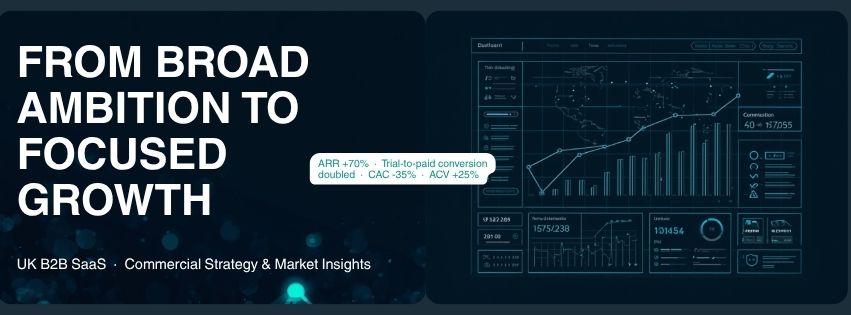
The client, an early-stage B2B SaaS business serving hotels in the technology deployment space, had developed a technically strong product and built a pipeline of trial users. But converting that interest into paying customers was proving harder than expected.
The business was generating healthy trial sign-up volumes but struggling to convert them into paid subscriptions. Marketing spend was spread across multiple channels and audiences with limited ROI. The founding team had a broad vision for who the product could serve — essentially any hotel — but no clear view of which customer profiles were actually most likely to buy, stay, and grow. Without a defined ideal customer profile, every sales conversation was different, pricing felt uncertain, and the product roadmap was pulled in too many directions at once.
The engagement began with a structured analysis of the existing trial and customer base — identifying the segments with the highest conversion rates, the lowest churn, and the strongest expansion revenue. This quickly revealed a concentration of success in two specific verticals: small independent hotels and boutique chains, both of which had acute tech-stack requirements that the product addressed particularly well.
A competitive market mapping exercise confirmed that neither segment was well served by existing solutions at the current price point. These findings were used to redesign the go-to-market strategy from the ground up:

A firm built on referrals had reached a ceiling. Structured BD strategy and targeted marketing activation unlocked a new channel for consistent growth.
Read case study
Stalled growth and thinning margins masked a simpler problem: the retailer didn't know who its most valuable customers were. Market research made it clear.
Read case study
Uneven performance across the estate wasn't an operations problem — it was a market problem. Site-level insight and targeted local activation turned it around.
Read case studyLet's explore what structured commercial thinking could unlock for your business.
Book a free consultation